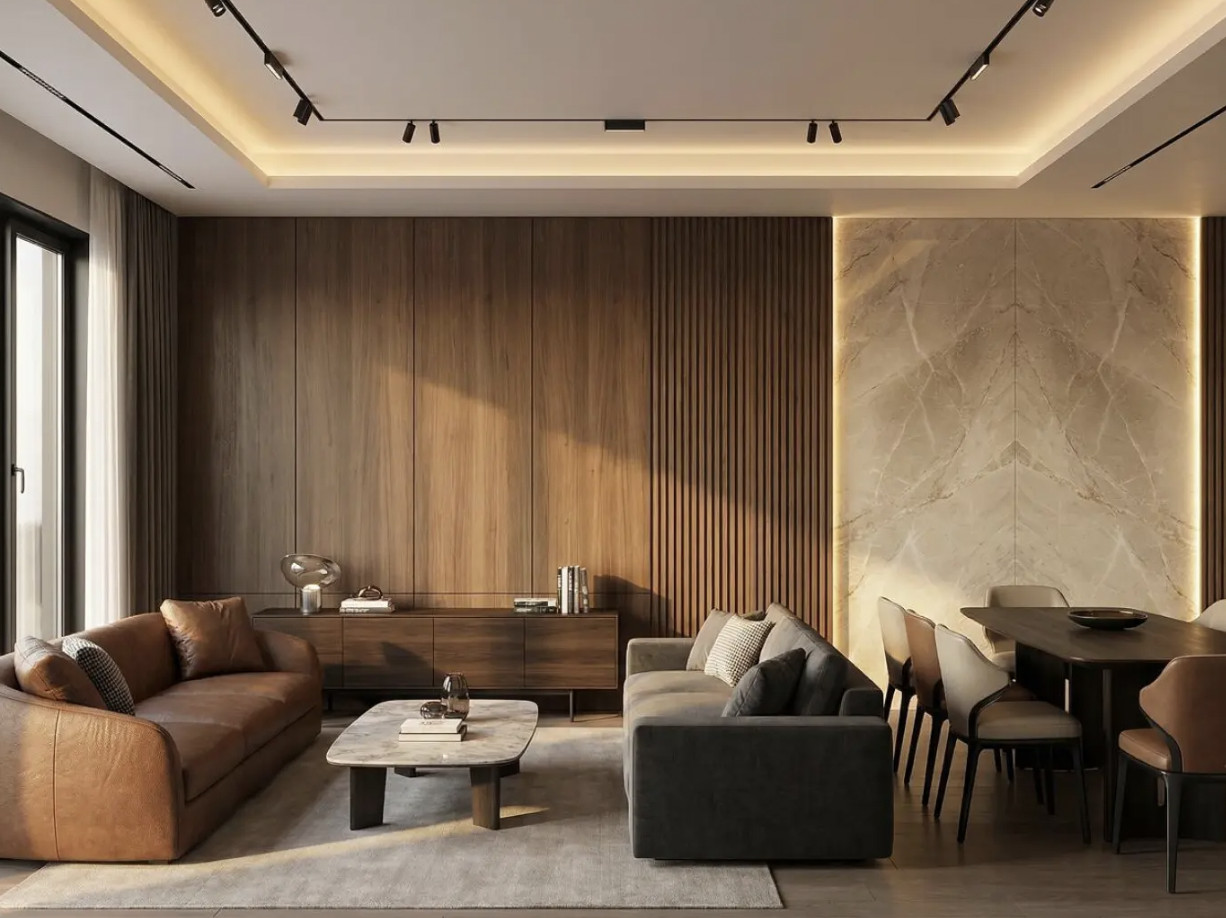
In many Singapore homes, especially 3-room HDB flats, space is shared between the living and dining areas. When a sofa sits too close to the wall or a dining table cuts into the walkway, the entire space can quickly feel cramped.
It’s a common situation where everything technically fits, but the layout doesn’t feel right. Movement feels restricted, certain areas go unused, and the home lacks a natural flow.
The way you arrange your furniture plays a big role in how your home feels every day. With the right placement, even a compact layout can feel more open, comfortable, and easy to live in.
 Interior Design Firm: Va Maison Design
Encouraging Flow and Movement
Tip: Maintain at least 700-900mm of walking space along your main circulation routes, especially the path between your front door, sofa, and kitchen, which is the backbone of daily movement in most HDB flats.
Take a 3-room HDB flat where the living and dining areas share a single open space. The sofa goes against the wall and the dining table sits opposite. It looks tidy. But the path from the front door to the kitchen now runs through the middle of both areas and everyone in the household navigates around furniture all day without realising it.
Pulling the sofa 30cm away from the wall and angling the coffee table slightly changes everything. The room stops feeling like furniture arranged around a perimeter and starts feeling like a space arranged around how people actually move. That central corridor, the path from door to kitchen, becomes intentional rather than accidental.
The gap between your sofa and coffee table matters more than the gap between the sofa and the wall. Get that right first. For layouts where living and dining share the same footprint, open-concept living rooms show how Singapore homeowners have handled the same challenge.
 Interior Design Firm: Columns n Graph
Creating Purposeful Zones
Tip: Orient furniture inward toward the centre of its zone, not toward the nearest wall. A sofa that faces the television and anchors around a rug reads as a room. The same sofa pushed flat against a wall reads as furniture waiting to be arranged.
In a 4-room BTO flat, the living and dining area together run roughly 25-30sqm. There are no walls between them. The sofa is in one part, the dining table in another, a work desk somewhere near the window and somehow the whole space feels like one large, slightly chaotic room where it's hard to properly relax or properly focus.
The fix isn't structural. The back of a sofa, turned slightly inward rather than pressed flat against a wall, tells the room where the living area ends. A rug underneath the dining table anchors that corner and gives it its own identity. A floor lamp beside an armchair creates a reading spot that doesn't need a wall or a partition to feel separate. Each piece starts doing two jobs: functioning as furniture and defining a boundary.
For homeowners who prefer a more expressive look, styles like eclectic interior design show how different elements can coexist while still maintaining intentional zones.
 Interior Design Firm: Whitehaus Interior Design
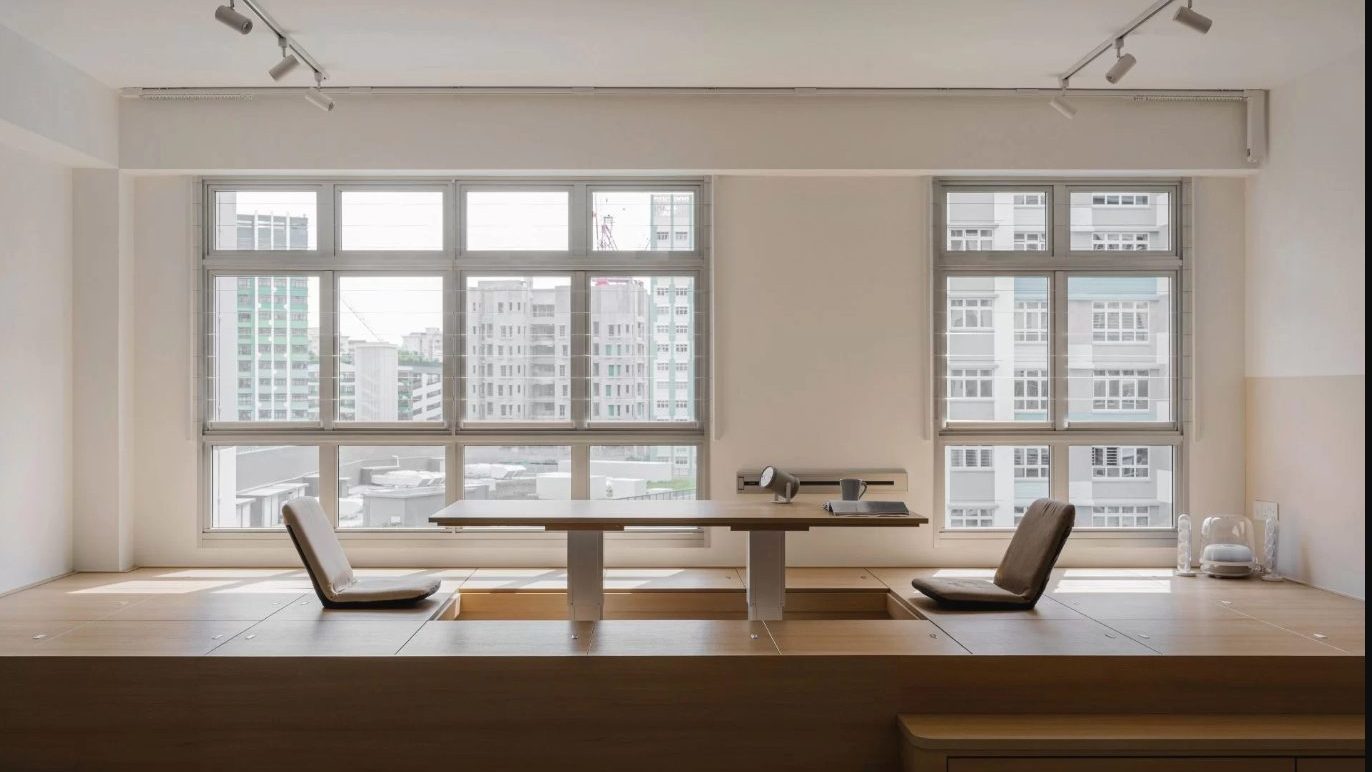
Maximising Natural Light and Views
Tip: Keep windows clear. Use low-profile furniture near window walls, and position mirrors on the wall opposite a window not beside it so they reflect daylight back into the room rather than deflecting it sideways.
There is a wardrobe in the spare bedroom of most Singapore flats full height, pushed against the wall beside the window because that wall is long enough to fit it. It looks fine. But from the moment it goes in, that room gets noticeably darker. The window is still there. The light just has nowhere to go.
This is the most consequential furniture placement decision in any Singapore home, and most people make it without thinking. A corridor-facing unit or north-facing flat already gets limited sun. One tall, opaque piece beside a window can make the difference between a room that feels liveable and one that feels dim regardless of the time of day.
The alternative isn't complicated. An armchair rather than a wardrobe. A low console instead of a full shelving unit. A mirror on the wall opposite the window not beside it so it reflects daylight back into the room instead of deflecting it sideways. For more on making the most of limited light, these tips to make your home look bigger cover the practical detail.
 Interior Design Firm: IH Design
Supporting Daily Activities
Tip: Spend a week noticing where things accumulate. In most HDB flats, the pile-up happens in the same three spots: just inside the front door, on the dining table, and at the end of the kitchen counter. Those are your layout's weak points, the places where furniture isn't supporting what people actually do.
The dining table in many Singapore homes stopped being a dining table within six months of moving in. The laptop arrived first, then the charger, then the stack of letters that never quite made it to the drawer. Dinner still happens there but only after clearing half of it. The study corner that was supposed to handle all of this has one problem: whoever set up the flat put it against a wall with no natural light.
This is what layout friction looks like in practice. Not a dramatic problem, just a series of small inconveniences that compound across every single day. Shoes at the door because there's no bench. A living room sofa that faces nothing in particular, so nobody sits there. A kitchen counter that collects things because the nearest surface to the entrance happens to be the kitchen counter.
Most of these are fixable without buying anything new. A bench near the door. The desk moved to the window wall. The sofa rotated to face the room instead of the wall. For more on designing around real daily habits, these tips for designing your dream home in Singapore into useful detail.
 Interior Design Firm: Concept Matters
Balancing Function and Aesthetics
Tip: Place large anchor pieces on the first sofa, dining table, and bed. Get their scale right before adding anything else. One piece that's 10cm too wide throws off every placement decision around it.
The sofa looked right in the showroom. It was the right colour, the right depth, and the salesperson confirmed it would fit. What nobody mentioned was that fitting and working are two different things. In a 3-room HDB living area, a 3-seater that runs longer than 2.1m fits against the wall just but it cuts off the natural path to the dining area. The coffee table has to move closer. The walkway narrows. The whole room starts working around one decision made in a showroom on a Saturday afternoon.
Scale is the thing most people get wrong, and it's the thing that makes everything else harder to fix. A piece that's 10cm too wide doesn't just look slightly large it repositions every other piece in the room. Once the anchor pieces are the right size, the rest becomes easier. Chairs with slim legs let light pass underneath. A console at the right height doesn't interrupt the sight line to the window. Surfaces that reflect light glass, polished stone, lacquer add depth without adding bulk.
Before buying, mark the footprint of any major piece on the floor with masking tape and live with it for a day. Walk around it in the morning when you're half-asleep. See whether it interrupts the path you take without thinking. If it does, it's too large regardless of how it looked in the showroom. For guidance on pieces that hold their value and their proportion over time, furniture pieces worth investing in is worth reading before any major purchase.
How to Start Rearranging Your Home
Tip: Before moving a single piece of furniture, take a photo of every room from the doorway. That distance reveals circulation problems and wasted space that you stop noticing when you live with them daily.
Stand at the front door of your flat and look straight ahead. That view, the one you see every single time you come home tells you more about what's wrong with your layout than any floor plan. If the first thing you see is the back of a sofa, the side of a wardrobe, or a wall of storage, the furniture is arranged for the room, not for the person living in it.
Start there. On a free morning, move everything in the living room to the edges and take a photo of the empty space. Three questions: where does the natural light land? Where does your eye go first? Where do you naturally walk? The furniture should follow those answers, not the other way around. In most HDB flats this means the sofa comes away from the wall, the coffee table moves closer to it, and the circulation path to the kitchen stays clear.
The living room is the right place to start because it connects everything else entrance, dining area, bedrooms. Get the furniture placement right here and the rest of the flat tends to follow. For a look at how other Singapore homeowners have reworked the same space, these open-concept living room transformations show what a single afternoon of rearranging can do.
 Interior Design Firm: Sora Studios
Homes that remain calm and effortless to live in don't happen by chance. They are shaped by deliberate decisions made early where circulation follows real routines, storage anticipates daily habits, and every piece of furniture earns its place.
Each choice works quietly in the background, reducing friction over time. When you're ready to put these principles into practice, take our quick quiz and we'll match you with a designer who can turn them into a home that truly feels yours.
FAQ
1. How far should a sofa be from the wall in an HDB flat?
Leave a gap of about 5-10cm behind the sofa to improve airflow and prevent a boxed-in look. More importantly, maintain 700-900mm in front of and beside the sofa, that's the circulation space that actually determines how the room feels.
2. Should furniture always be placed against the wall?
Not always. Pushing all furniture against the walls often creates a hollow centre with congested edges the opposite of what most homeowners intend. Leaving small gaps and pulling pieces slightly inward usually creates more usable, comfortable space.
3. How do you create zones in a small 3-room HDB flat?
Use furniture orientation, rugs, and lighting rather than walls. The back of a sofa can mark the boundary of a living zone. A rug anchors a dining area. A floor lamp defines a reading corner. The key is orienting each piece toward the centre of its zone, not toward the nearest wall.
4. What furniture works best for small Singapore homes?
Low-profile, space-saving, and multi-functional pieces work best storage beds, extendable dining tables, sofas with slim legs. More important than the individual piece is getting the scale right: one oversized anchor item throws off every placement decision around it.
5. What is the best layout for a small living and dining area?
Keep the main circulation path from your front door through the living area to the kitchen at least 700-900mm wide and uninterrupted. Use the sofa to define the living zone and keep the dining table clear of that path. A rug under the dining table helps separate the two areas without any structural changes.