
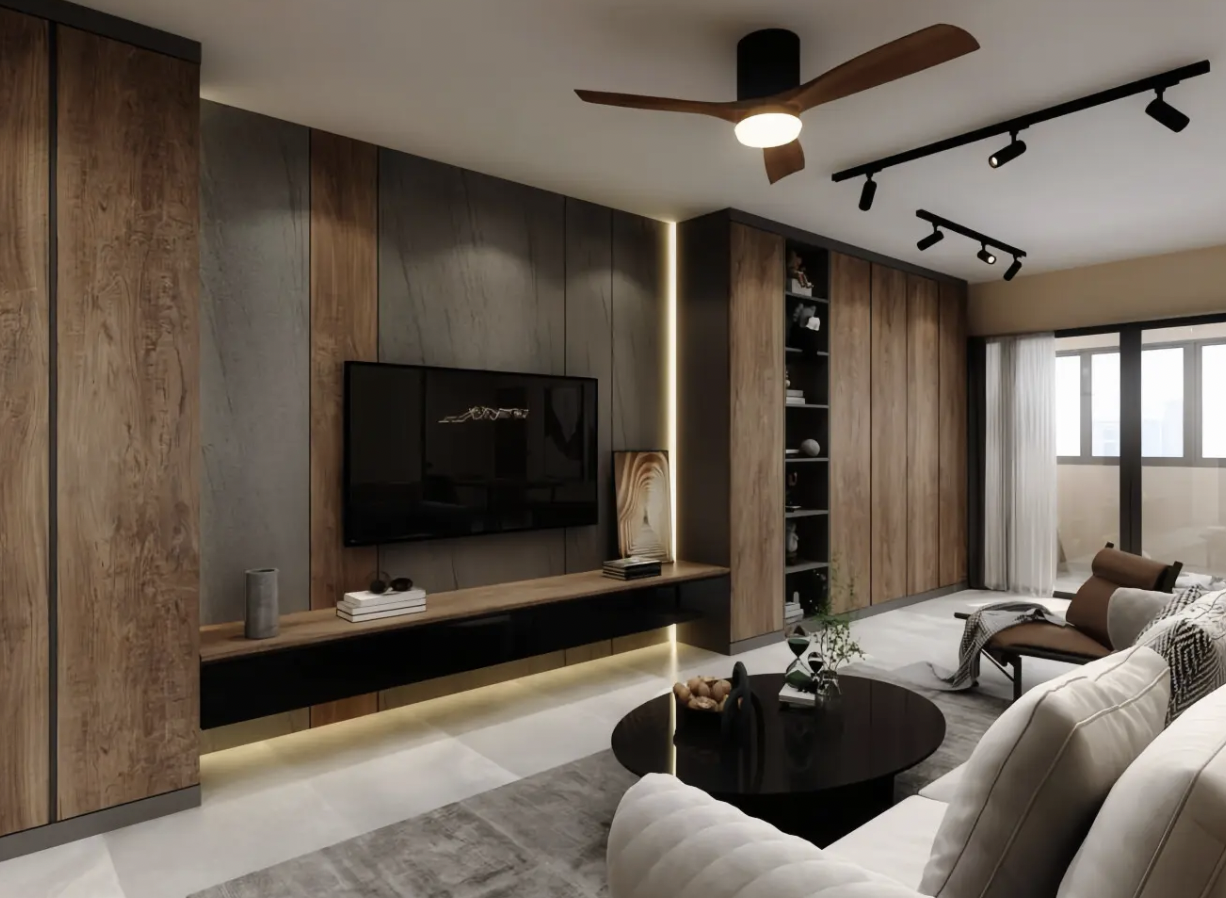
Walk into a recently renovated Singapore home and you can usually tell within thirty seconds whether money was spent wisely or just spent. The marble is on the floor, the feature wall, and the bathroom. The lighting shifts colour with a tap on the phone. Every surface has something on it. And somehow, despite all of it, the home feels exhausting rather than restful.
A four room flat in Tampines with quiet finishes, good storage, and a layout that actually flows can feel more refined than that penthouse. Not because it cost more it almost certainly didn't but because every decision was made in service of the people living there, not in service of an impression.
In Singapore's compact HDB flats and condos, a premium feel rarely comes from adding more. It comes from making the space feel calmer, more intentional, and easier to live in every single day.
 Interior Design Firm: The Three Masons
A Calm Layout Always Feels More Expensive
Tip: Before adding any new piece of furniture, check whether it interrupts the main path through the room. In a 3 room HDB where living and dining share roughly 18-22sqm, one oversized piece can make the entire flat feel smaller than it is.
The renovation has just finished. The sofa the homeowner chose in the showroom, the one that looked perfect surrounded by empty floor space, now sits in a 3 room HDB living area alongside a dining table and a TV console. The walkway between them is barely 50cm. The room, which looked generous in the floor plan, now feels like furniture storage.
This is one of the most common premium feel mistakes in Singapore homes, and it has nothing to do with budget. A sofa that runs longer than 2.1m in a compact living area doesn't just look slightly large, it forces every other piece closer together, narrows every walkway, and makes the room feel like it was furnished by accident rather than by design. The fix is rarely buying something new. It is usually pulling pieces slightly inward, widening the central circulation path, and letting the room breathe.
Homes that feel elevated are almost always restrained in their layout choices. Instead of filling every corner, they allow the eye somewhere to rest. That openness, the deliberate absence of things is what creates the calm that reads as luxury. For practical ways to make any Singapore flat feel larger without structural changes, explore 10 little things you can do to make your home look bigger.
 Interior Design Firm: Hatch Design Studio
Lighting Does More Work Than Any Finish
Tip: Use warm white lighting 2700-3000K throughout living and bedroom areas. Layer it: cover lighting for ambience, wall lights or floor lamps for task areas, downlights only where function requires them.
Most Singapore homeowners spend months choosing tiles and carpentry finishes, then wire the entire flat with a single row of recessed downlights on one circuit. The renovation is complete. The lights go on. The home looks like a well finished office.
Downlights alone, especially cool white ones above 4000K flatten a space. They eliminate shadow, which is the thing that gives a room depth. In a west-facing Singapore unit that already receives intense afternoon sun, harsh overhead lighting at night makes the home feel relentless rather than restful. Warm layered lighting solves this cove lighting that washes a wall softly, a floor lamp beside a reading chair, a pendant over the dining table that pools light downward instead of scattering it everywhere.
Consistency across rooms matters too. When the living room uses warm 2700K lighting and the kitchen uses cool 6000K, the home feels visually disconnected every time someone walks between the two. Choosing one warm tone throughout and layering it differently per room creates the kind of cohesion that makes a home feel considered rather than assembled. For homeowners working within a budget, read achieving luxe lighting on a Budget for your home.
 Interior Design Firm: Joust Interior Design Studio
Fewer Materials, Used Well, Always Outperform Many
Tip: Pick two or three materials and repeat them across the home one for floors, one for cabinetry, one for countertops. Consistency between rooms makes a compact Singapore flat feel larger and more cohesive.
There is a renovation in almost every Singapore condominium that uses four different flooring materials across five rooms. Herringbone timber in the living area. Large format tiles in the dining space. Carpet in the master bedroom. A different tile in each bathroom. Each material was chosen individually and each looks fine in isolation. Together they make the flat feel like a showroom of samples rather than a home.
Premium interiors tend to work in the opposite direction. One floor material carried consistently from the living area through the bedrooms makes the flat feel larger the eye doesn't stop and reset at every threshold. Matte finishes age more gracefully than high-gloss laminates that show fingerprints and scratches within weeks of moving in. Natural wood tones that weather over time feel more honest than finishes that try to look expensive but reveal their quality the first time someone drags a chair across them.
The physical experience of materials matters as much as the visual. Soft close drawers, smooth cabinet edges, and solid countertop surfaces shape how the home feels to use every day. These details are not noticed consciously when they are right, they are only noticed when they are wrong. Homeowners deciding where to invest can find useful guidance in this breakdown of the best furniture pieces to invest in for long-term use, which covers what holds its quality over time.
 Interior Design Firm: Whitehaus Interior Design
Hidden Storage Is What Actually Makes a Home Feel Premium
Tip: Prioritise concealed storage in the three highest-clutter areas the entrance, the kitchen counter, and around the TV. Keeping surfaces clear in these spots does more for the premium feel of a home than almost any decorative upgrade.
An hour after the professional interior photography wraps up, the home looks exactly like every Singapore renovation blog. The kitchen counter is clear. The entrance is uncluttered. The living room has three carefully placed cushions and nothing else. Six months later, the same home has a row of appliances on the counter, shoes at the door, and a collection of chargers behind the TV console. The renovation was expensive. The result looks ordinary.
This is not a styling problem. It is a storage planning problem. In Singapore homes where space is genuinely limited, storage that does not account for real daily habits fails immediately. A shoe cabinet that only fits six pairs when the household has three people and twelve pairs. Kitchen drawers that are too shallow for anything useful. A TV console with no cable management. Each gap forces something visible onto a surface where it does not belong.
The homes that hold their premium feel over time are the ones where storage was planned around how the household actually lives, not around how the homeowner hoped they would live. Concealed storage near the entrance, deeper kitchen drawers, and hidden cable runs around the TV area keep surfaces clear without requiring constant effort. For storage ideas specific to compact Singapore layouts, read smart storage for compact Singapore homes: clever design tips.
 Interior Design Firm: Design Direct
Good Carpentry Is Quiet, Good Details Are Invisible
Tip: Align carpentry panel heights with door frames and ceiling lines. Flush handles, consistent gaps, and clean transitions between materials cost nothing extra but change how polished the finished home feels.
Some homeowners feel pressured to fill every wall. Feature niches, display shelves, fluted panels, and textured feature walls appear in every room. The contractor builds what is asked. The result, in a 4 room HDB flat, is a home that feels heavy every surface competing for attention, no wall left to rest the eye.
Good carpentry in a Singapore home is usually the carpentry you stop noticing after the first week. Flush cabinet faces that align with the door frame. Handle profiles that are consistent from room to room. A built-in wardrobe with the same gap spacing as the kitchen cabinetry. These details do not create drama, they create the quiet sense that someone thought carefully about everything, which is exactly what a premium feel requires.
The same principle applies to the smaller decisions. A power point positioned where it is actually needed rather than where it was convenient to run the cable. Smooth transitions between flooring materials at thresholds. Acoustic consideration in open plan layouts where hard floors and high ceilings amplify every sound. None of these appear in a renovation portfolio photograph, but all of them shape how the home feels six years after move in. For the habits and details that create a genuinely calm home, read minimalist interior design Singapore.
 Interior Design Firm: Interior Homes Design Studio
The Homes That Age Best Were Designed For Real Life
Tip: Before committing to any finish or feature, ask whether it will look the same and feel the same to maintain three years after move in. Most trend-driven decisions fail this test.
Many Singapore homeowners arrive at their first renovation meeting with a folder of hotel references. Dark marble bathrooms. Dramatic pendants. Oversized mirrors on every available wall. The references are beautiful. Hotel rooms are also cleaned daily by a professional, used for an average of two nights, and never have a six-year-old eating breakfast in them.
A home that feels genuinely premium after five years of daily life is one where the original decisions held up. Surfaces that are easy to clean. Seating that remains comfortable after an hour, not just for the first five minutes. Lighting that feels warm in the evening rather than interrogative. Materials that age to look worn in rather than worn out. The homes that achieve this are usually not the most dramatic ones. They are the most considered ones.
In Singapore's compact layouts, this consideration extends to acoustics. Open-plan flats with hard flooring and no soft furnishings amplify every conversation, every chair movement, every sound from the kitchen. Rugs, curtains, upholstered furniture, and softer ceiling treatments absorb that noise. The home becomes quieter. Quieter homes feel calmer. Calmer homes feel more expensive. It is rarely the thing anyone thinks about during a renovation, and it is almost always the thing people mention when asked why their home feels right to live in. For renovation decisions that protect long-term value, read 9 renovation tips that help future proof your property resale value.
 Interior Design Firm: Maison Interior
A home that holds its premium feel is not the one that impressed every visitor in the first month. It is the one that still feels good to come home to three years later where nothing has dated badly, nothing requires constant upkeep, and the layout still supports the way the household actually lives.
When you are ready to work with a designer who understands how Singapore homes age and how to make the right decisions early, take our quick quiz and we'll match you with someone who does.
FAQ
1. Why does my renovated HDB flat not feel as premium as I expected?
The most common reason is layout. A renovation can use good materials and still feel ordinary if the furniture is too large for the space, the lighting is flat, or storage wasn't planned around real daily habits. Premium feel comes from how the home functions, not just how it looks immediately after renovation.
2. What makes a home look expensive without spending more?
Consistency and restraint. Using two or three materials carried across all rooms, keeping surfaces clear of clutter, choosing warm layered lighting over a single ceiling light, and ensuring furniture is the right scale for the space these decisions cost no more than their alternatives and make a more significant difference.
3. How do I make a small Singapore condo feel more luxurious?
Start with layout and storage. Clear the main circulation path through the living area. Conceal the clutter that accumulates at the entrance, kitchen counter, and around the TV. Then address lighting replace cool overhead lights with warm layered alternatives. These three changes affect how the home feels every day without touching the finishes.
4. Is it worth spending more on carpentry in an HDB flat?
Only if the carpentry solves a real storage or functional problem. Built-ins that conceal clutter efficiently add long-term value. Feature panels and display niches that fill wall space without improving function often make compact flats feel heavier. The quality of detailing flush finishes, consistent gaps, clean transitions matters more than the quantity of carpentry.
5. What interior design mistakes make Singapore homes feel less premium over time?
Trend-driven finishes that date quickly. Insufficient storage that forces clutter onto surfaces. Oversized furniture that narrows walkways. Cool overhead lighting that makes living areas feel like offices. And materials chosen for how they look in photos rather than how they hold up to daily Singapore life humidity, heavy use, and families who actually cook in their kitchens.


